 01 / 01
Cognitive & Neuro
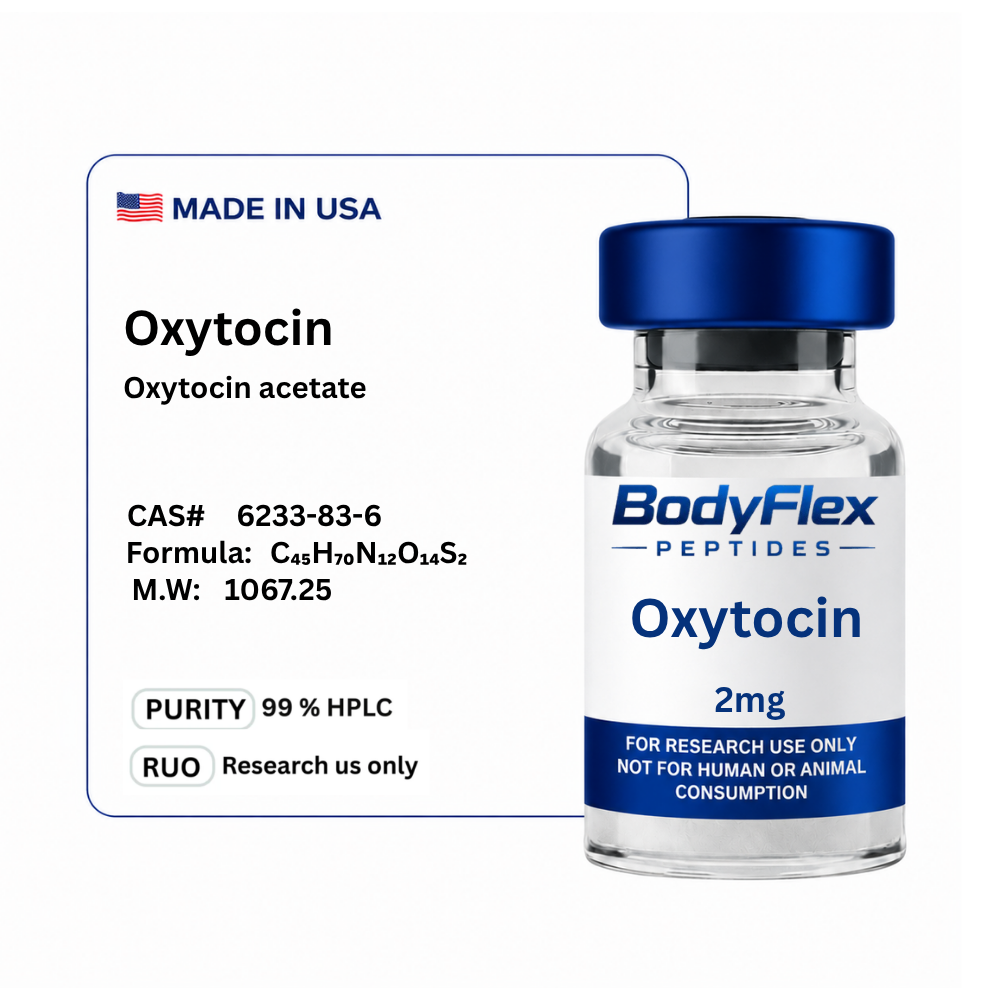
Oxytocin
2 mg
Oxytocin acetate · Research peptide
COA Available Batch Documentation● In Stock
Price$29.99
Oxytocin is a 9–amino acid cyclic neuropeptide hormone produced in the hypothalamus and released by the posterior pituitary, studied for its role in reproductive, social, and affiliative behaviors.
For laboratory research use only. Not for human or animal consumption.
Secure checkout Tracked shipping Documentation available
Additional information
- Full name
- Oxytocin acetate
- CAS number
- 50-56-6
- Molecular formula
- C₄₅H₇₀N₁₂O₁₄S₂
- Molecular weight
- 1067.25 g/mol
- Purity
- 99% HPLC
- Form
- Lyophilized powder
Identifiers as printed on the product label. Refer to the lot-specific COA for batch data.
Handling & warranty
Reconstitution Warranty Notice (Research Use Only)
For laboratory research use only. Not for human use.- Lyophilized peptides should be reconstituted using proper aseptic laboratory technique.
- Reconstitution should be performed using the recommended bacteriostatic water and handled according to accepted research practices.
- Any applicable warranty related to reconstitution, sterility or material integrity is subject to the stated handling requirements.
- Use of unsuitable third-party diluents or deviation from provided handling guidance may affect applicable warranty coverage.
01Product details
Overview
Oxytocin is a cyclic 9–amino acid peptide (Cys-Tyr-Ile-Gln-Asn-Cys-Pro-Leu-Gly-NH₂) with an internal disulfide bond. It was the first peptide hormone to be sequenced and chemically synthesized, by Vincent du Vigneaud, who received the 1955 Nobel Prize for the achievement.
Research Background
Oxytocin has been studied extensively in research on reproductive physiology (parturition, lactation), social behavior, pair bonding, anxiety, and stress response. It is a foundational reference compound in social neuroscience research.
Storage & Handling
Store lyophilized peptide at -20°C for long-term stability. Once reconstituted with bacteriostatic water, store at 2–8°C and use within recommended timeframes. Handle under sterile laboratory conditions and avoid repeated freeze-thaw cycles.
Disclaimer:
This product is for laboratory research use only. It is not intended for human or animal consumption or for use in any diagnostic, therapeutic, or clinical applications.
02Mechanism of action
Oxytocin binds the oxytocin receptor (OXTR), a Gq-coupled GPCR, expressed in the uterine myometrium, mammary tissue, and several brain regions including the hypothalamus, amygdala, and reward circuits. Receptor activation triggers PLC/IP₃/Ca²⁺ signaling. Peripheral effects include uterine contraction and milk ejection; central effects include modulation of social cognition, fear extinction, and HPA-axis regulation.
03Research applications
Oxytocin is studied in research on reproductive physiology, social behavior, pair bonding, stress response, and anxiety. It is a foundational reference peptide in both endocrinology and social neuroscience.
04Technical specifications
CompoundOxytocin
Full nameOxytocin acetate
Strength2 mg
CAS number50-56-6
Molecular formulaC₄₅H₇₀N₁₂O₁₄S₂
Molecular weight1067.25 g/mol
Research areaCognitive & Neuro
FormLyophilized powder
Purity99% HPLC (per label)
DocumentationCOA available
05Certificate / documentation
Certificate of AnalysisLot-specific documentation
AvailableCertificates of Analysis are issued per lot. Request the COA for your lot and our team will send it to you by email.
Continue browsing
Related research materials